
We have created
a new script
called 'Jolom Sini'
to write our language.

Kharia Lebu (Humans)
The Kharia Adivasi Lebu, primarily residing in the central Indian states of Jharkhand, Chhattisgarh, West Bengal, and Odisha, is divided into three sub-groups: Dudh Kharia, Dhelki Kharia, and Hill Kharia. Each sub-group has its own distinct cultural practices and traditions, reflecting their rich knowledge tradition and diverse heritage.
Traditionally, the Kharia Lebu (Human) are skilled farmers practicing shifting cultivation. They used to rely on agriculture and forest resources for their livelihood, but in modern times, they are engaged in a variety of occupations, ranging from high administrative positions to daily wage labor. However, their traditional lifestyle has undergone significant changes due to external religious, political, and economic interventions over the past century, as well as recent environmental changes and social pressures.
The rich cultural heritage of the Kharia Adivasi community is evident in their language, music, dance, and art. Their unique ancestral songs and stories, passed down through generations, provide insights into their deep connection with nature and their ancestors.
The first detailed monograph on the Kharia Adivasi community was written by S.C. Roy, titled "The Kharias," published in two volumes in 1937. You can find Volume 1 and Volume 2 here.
Kharia Lang
Kharia is an Austroasiatic language spoken by the Kharia Adivasi Lebu in India. Linguists have classified it under the southern branch of the Munda subgroup of the Austroasiatic language family. It is an ancient language with its closest relative being the Juang language. These are the only two languages in the southern Munda branch. There are 482,754 Kharia speakers in India.
Traditionally, Kharia has been an oral language with a history of being spoken for approximately sixty thousand years. Although categorized under the Munda subgroup, it differs significantly from other languages in this subgroup such as Asur, Birhor, Birjia, Mundari, and Santali. The earliest study on the Kharia language, "Introduction to the Kharia Language" by Gagan Chandra Banerjee, was published in 1894.
Kharia is a tonal language, meaning the tone of a syllable can change the meaning of a word. It also has a rich system of affixes and grammatical particles, making it a complex and fascinating language for linguistic study.
Despite being a minority language, it remains an integral part of the cultural identity of the Kharia Lebu, playing a crucial role in preserving their oral traditions, ancestral narratives, songs, stories, and wisdom.
For almost a century, people have been creating Kharia scripts, and our effort is the latest in this endeavor.
The Kharia Writing System
Like other Adivasi languages, Kharia has primarily been an oral language. However, during the colonial era, when British administrators and missionaries began studying the knowledge traditions of the Adivasis through anthropological research on their society, culture, history, and language, the writing of Adivasi languages commenced. Kharia was first written in the Roman script, then in Devanagari, Odia, Bangla, and other Indian scripts. In Jharkhand, it has mainly been written in the Devanagari script.
Why the need for a script? In ancient times, there was no need for a script. The entire clan lived together, and there was no need for any other technology for their communication, interaction, and sharing. Their work was done effortlessly through oral and physical gestures, special signs and sounds, and some permanent and temporary measures.
With the socio-economic intrusion of the outside world, this situation began to change by the twentieth century. The spread of education and the system imposed by the outside world trapped the ancestors in a web of leases. Although they fought against it, the British, with the help of local moneylenders and landlords, forced them to accept the external culture of literacy through religion, deceit, and violence. However, neither the British nor the Indian Constitution recognized Adivasi languages. By creating obstacles in written literature, grammar, and script, they distanced us from our own languages.
The need and importance of a script are divided into several dimensions. It is not only a medium of personal and social communication but also a tool for the compilation and preservation of knowledge, culture, and civilization. Without it, the development and progress of human society would not be possible. The importance of script is as relevant in today's digital age as it was in ancient times, as it is the most effective means of permanently documenting human thoughts and emotions.
Like other Adivasi communities, the Kharia people also took the initiative to overcome this obstacle. They created literature, wrote grammar, preserved oral ancestral knowledge traditions, documented them, and even created scripts. In the early twentieth century, Nuas Kerketta created a Kharia script. After that, Karlus Dungdung from Taraboga in Biru Pargana developed the another Kharia alphabet and script. Around the same time, another script was created by Birmitrapur MLA Junas Bilung. Ambrus Soreng is also among those who created scripts. The most recent name among script creators is Christopher Dungdung. In 2020, he created a new script called 'Kalga Lungtoya,' which was accepted at a meeting in Ranchi on July 16, 2023. And now, in 2024, we, the Pyara Kerketta Foundation, are presenting you with another new Kharia script, Jolom Sini.
Jolom Sini
'Jolom' means painting and 'Sini' is used for plough. The script presents language and sounds in a new form. Painting or whitewashing also give the house a new beauty and a new 'look'. If there was no 'Sini', it would not have been possible to write easily on earth. The Kharia people were called farmers by plowing the plow and grew food for living. In this way both the words are carriers of the original Kharia culture and give special context to the meaning of 'script' and 'writing'. We also cultivate words through script and produce precious 'food' of dialogue, communication and sharing.
Another reason for naming 'Jolom Sini' is the unity of the Adivasis. The Santals named their script 'Olchiki', the Ho people named 'Warangchiti' and the Oraons named their script 'Tolong Siki'. 'Jolom Sini' carries forward this rhythm of scripts and strengthens Adivasi solidarity.
Shape, type and use of 'Jolom Sini'
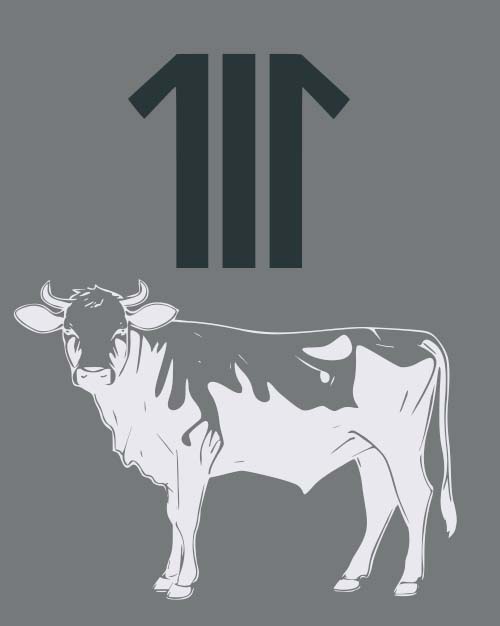
This Kharia script is very easy. It has been created according to Kharia culture and tradition. The glimpse of many elements of Kharia culture will be found in its forms. Like - mother, human, Basali cow, elephant, trees and plants, animals and birds, Musical instruments, and Kharia identity 'Khoda' (Tattoo). All its letters can be easily memorized and written.
Kharia Font 'Konjoga'
The first font of the 'Jolom Sini' script, 'Konjoga' version 01 is ready (download font), a glimpse of which you can see in this introduction booklet (download booklet). This script has been created according to the Devanagari keyboard. That is, any person who types in Devanagari or Roman in mobile, tab, iPad, laptop or desktop computer can write this script blindly in the same way. To learn and type this script, neither you have to learn a separate keyboard nor any kind of special training is required. It's very easy. Just install the font in your laptop and PC or other device and start writing. Once the Kharia Unicode font is available, you will not even need to install it. Then you will be able to easily write in your Kharia script 'Jolom Sini' anywhere in the world, just like Mangal.
We need everyone's cooperation
Pyara Kerketta Foundation appeals to all of you that 'script' is an essential tool in the digital world. Even the smallest languages around the world have geared up to save their linguistic and cultural existence through script. Many Adivasi scripts are available on Google with Unicode fonts. 'Jolom Sini' is a strong step to save, preserve and promote Kharia knowledge tradition and linguistic ability. Through this script, the Foundation salutes the efforts of all those Kharia scholars who have created Kharia script from time to time.
Let us all unite to make their dreams come true. Adopt 'Jolom Sini'. Send your feedback, criticism and suggestions so that it can become a practical script of Kharia community in the true sense.
From August 9, 2024, the first font of the 'Jolom Sini' Kharia script, 'Konjoga' version 01 will be available on the Foundation's website www.jolomsini.kharia.org along with the keyboard map, Kharia primer and all other necessary information. Which you can download and use. After using it, do send us your suggestions for the shortcomings in the script and font so that it can be made more beautiful. Your complaints and affection will be awaited.
Jai Johar. Jai Kharia. Jai Adivasi.
Regards,
Vandna Tete
Pyara Kerketta Foundation
Ranchi-Simdega (Jharkhand)












Get started with Konjoga font of the Jolom Sini Kharia script!
Let's take the Kharia language into the digital age. Adopt the Kharia script 'Jolom Sini' and be a part of the beginning of a new era for the Kharia language with the 'Konjoga' font.
Download Konjoga Font for WindowsDownload Konjoga Font for Mac